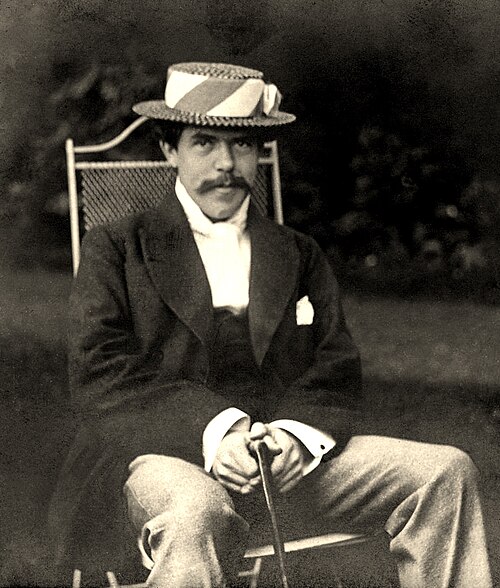
 Nathaniel Wedd (April 10, 1864 - September 27, 1940) was a prominent classical scholar, academic, and a deeply influential figure within early
twentieth-century Cambridge intellectual circles.
Nathaniel Wedd (April 10, 1864 - September 27, 1940) was a prominent classical scholar, academic, and a deeply influential figure within early
twentieth-century Cambridge intellectual circles.Queer Places:
University of Cambridge, 4 Mill Ln, Cambridge CB2 1RZ
4 Clifton Rd, London SE25 6NL, UK
St. Mary's Churchyard, Credenhill, Hereford HR4 7DL, United Kingdom
Nathaniel Wedd (April 10, 1864 - September 27, 1940) was a prominent classical scholar, academic, and a deeply influential figure within early
twentieth-century Cambridge intellectual circles.
Born at 13 Trinity Square, Tower Hill, London, he was the only son of Charles Wright Wedd, a corn-merchant, and Charlotte Wedd. His father passed away while Nathaniel was young, leaving him to be principally raised by his mother in an environment that encouraged independent thought and freethought.
Wedd received his early education at the City of London School before entering King's College, Cambridge, in October 1883 as a scholar. He had a distinguished academic career, achieving a First Class in Part I of the Classical Tripos in 1885, followed by a First Class in Part II in 1887. His exceptional aptitude led to his election as a Fellow of King's College in 1888, a position he held for the rest of his life.
Over the decades, Wedd served King's College and the wider university in various educational and administrative capacities, including assistant tutor from 1892 to 1912, university lecturer in ancient history from 1901 to 1912, and college librarian from 1919 to 1922. Although he published relatively little outside of editing Euripides' Orestes, he was celebrated for his pedagogical genius. Alongside contemporaries like Goldsworthy Lowes Dickinson, Wedd helped foster the inspirational, individualistic atmosphere that defined King's College at the turn of the century. He was also a foundational member of the Cambridge Apostles, the elite and intellectually rigorous secret society, connecting him with notable figures such as Roger Fry and J. M. E. McTaggart. In 1903, Wedd, Dickinson, and G. M. Trevelyan helped found The Independent Review, an intellectual journal aimed at encouraging a progressive, left-leaning liberal approach to politics and foreign affairs.
Wedd exerted a profound, formative influence on a generation of students, most notably the novelist E. M. Forster. Forster frequently credited Wedd as the singular catalyst for his intellectual awakening, noting that Wedd taught him to trust his own mind and instilled a lifelong love for classical Greece alongside progressive social and political ideals. Politically and religiously, Wedd was a committed humanist and freethinker. He attended the South Place Ethical Society, deeply admired the American freethinker Moncure D. Conway, and was famously vocal in his opposition to organized religion, once famously dismissing complaints about playing croquet on Sundays by stating he deplored a faith too fragile to survive the click of croquet balls.
In his personal life, Wedd married Rachel Evelyn White on August 23, 1906, in Grantchester, Cambridgeshire. Rachel was the second daughter of Dr. John Forbes White of Aberdeen and had herself served as a classical lecturer at Newnham College, Cambridge. Later in life, declining health compelled Wedd to step back from his active educational and administrative duties. He passed away on September 27, 1940, at the age of 76 in Hereford, and was buried in Credenhill, Herefordshire. His obituary in The Times remembered him as a fiery, witty, and fiercely independent spirit who dedicated his entire life and formidable intellect to the service and inspiration of youth.
References:
 The Cambridge Apostles, 1820-1914: Liberalism, Imagination, and Friendship in British Intellectual and Professional Life 1st Edition by W.C. Lubenow |
Other references:
Support this project
This website is a passion project researched, developed, and funded entirely by me. If you find the content valuable and would like to help support the ongoing research and hosting costs, any contribution is deeply appreciated.
Thank you for keeping this independent resource alive!
My books on Amazon: Elisa Rolle's books